This Christmas at our family gathering in Scotland, my sister turned to me and asked, ‘Where is God while Gaza is being bombed?’
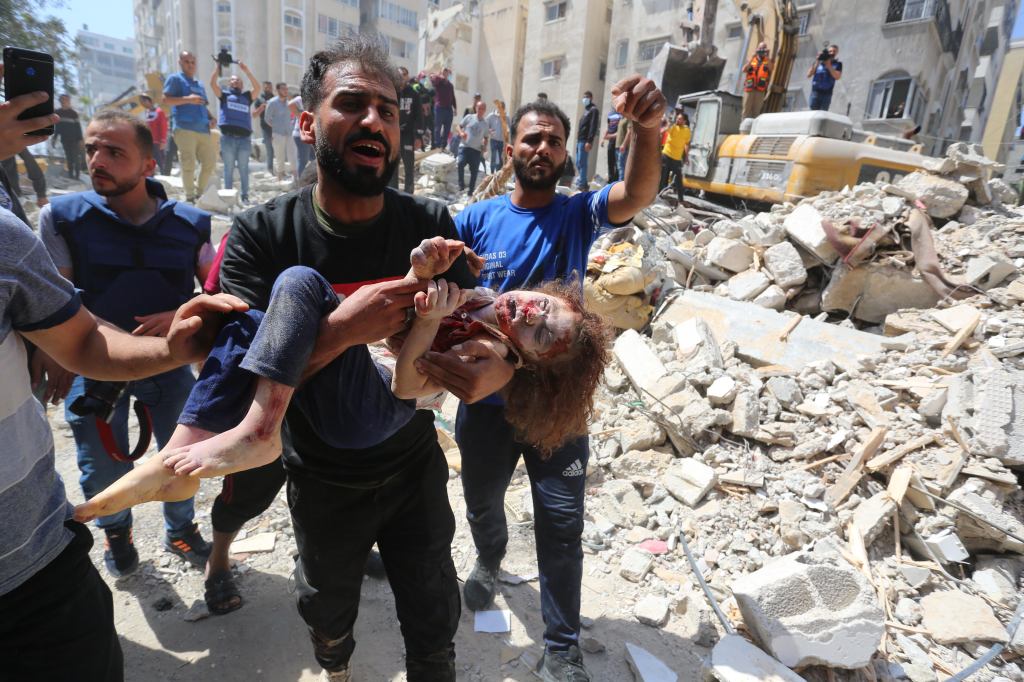
I get questions like this thrown at me because there aren’t many of us in the family with a faith. And it’s a fair question. This post may or may not answer it very well, but for what it’s worth, here are my thoughts as someone who believes that God is real, loving and good. If you have the same question as my sister, whether you have any faith at all, I hope you’ll read it with an open mind. Actually it’s come as a relief to write it down because for me, Christmas has been consumed by Gaza.
I’ve been unwell the whole Christmas break with a chesty cold. Being ill has felt entirely appropriate, as I’ve doomscrolled through endless posts about the war on social media. I used to only look at Instagram for reels of cats being adorable – but when the war started I began following the most prominent reporters and activists. Here were the human stories, the perspectives and the history I hadn’t found on mainstream Western media. Now when Instagram offers me cats, they are cats in Gaza, being cuddled by displaced children or reacting in terror to bomb blasts.
God is pro-justice, not pro-religion
Can I be absolutely clear about how I see this? What’s happening in Gaza is evil and wrong. It’s not Israel ‘defending itself’. This is deadly, aggressive action against people who were already living under military rule where their human rights were violated daily. It’s the logical conclusion of 75 years of oppression, colonisation and apartheid by the Israeli government. It is now genocide.
And this is not a war between religions. This is not about Muslims vs Jews or Christians. Some of the most inspiring people taking a stand against the slaughter in Gaza are deeply religious Jews.(“It’s against my religion”, said this Jewish protestor)
All three religions coexisted peacefully for centuries in Palestine before WWII. I saw a moving video of an older Christian priest making a promise to a young Muslim man – that if the Muslim call to prayer falls silent in Gaza because all the mosques are bombed, the Christian priest will make sure it rings out from the churches instead.
No, rather than being a religious war, this is a war of oppression and land grabbing, fuelled by decades of Israeli government propoganda that dehumanises Palestinians. And the first thing I am convinced of when I think about God and Gaza, is that his1 heart is broken by the oppression, injustice, violence and hatred. You may not know this if you’re not familiar with the Bible, but a continual theme is that God is a God of justice who champions the poor and the oppressed. Love and justice trump ‘religion’, every time. It’s not about what religious tribe you’re in or what box you tick or which side of the tracks you grew up on or what worship songs you sing. Listen to the prophet Amos, railing against religious people in the Israel of his time:
There are those who turn justice into bitterness and cast righteousness to the ground.
“I hate, I despise your religious festivals; your assemblies are a stench to me.
Even though you bring me burnt offerings and grain offerings, I will not accept them.
Though you bring choice fellowship offerings, I will have no regard for them.
Away with the noise of your songs! I will not listen to the music of your harps.
But let justice roll on like a river, righteousness like a never-failing stream!”
Amos 5
It horrifies me to think there are evangelical Christians who support Israel’s actions, based on a warped understanding of biblical prophecy. These people must have tied themselves in serious theological knots, and shut down their own consciences, to convince themselves that God is calling for the mass killing of civilians and theft of their land.2
So where is God then? Why is he letting this happen?
This is such an ancient and deeply human question – especially from people of faith. It’s threaded through the psalms:
“Why, Lord, do you stand far off? Why do you hide yourself in times of trouble?”
Psalm 10:1
“My God, my God, why have you forsaken me? Why are you so far from saving me, so far from my cries of anguish?”
Psalm 22:1, quoted by Jesus on the cross
It feels as though, time and time again throughout history’s most appalling atrocities, God has sat back with his arms folded – maybe had a little nap. Disengaged, disinterested, or just non-existent. How could a loving and compassionate God simply look on while babies are blown to bits?
Back in 2004 this was my reaction to the Boxing Day tsunami in Indonesia. I watched the news in horror – so many killed, including children torn out of their parents’ arms and swept to their deaths – and I was furious with God. I’d had too much experience of relationship with him to conclude that he didn’t exist, so I could only think that he was a callous and uncaring monster. I refused to speak to him for two days. (Then something happened which I’ll explain later.)
Nowadays my understanding of God’s character has deepened to the point that I know, viscerally, that God allowing terrible things to happen is not the same thing as God not caring. I know many people struggle with the concept of God having emotions – it’s hard enough to imagine a transcendent God as a person who thinks and speaks, without also trying to imagine one who feels. But daily experience of his spirit in prayer and familiarity with scripture has taught me that God is a God of deep emotions. The prophets and the psalms attribute highly emotional language to him, and then in every gospel, we find Jesus weeping, shouting with joy and, wonderfully, losing his temper. In times of prayer I often find myself overcome with an emotion that isn’t exactly mine but helps me to pray, which I’ve learnt to recognise as his spirit.
So, when I think about his reaction to Gaza I do not picture God as aloof or uncaring. I see him weeping, groaning, his whole body contorted with grief. I see him throw himself face down in the dust, hands pounding the ground, covering his face, pulling out his hair. The heartrending expressions of unbearable grief we’ve seen on social media as Palestinians mourn their loved ones – I think these reflect what God’s grief might look like if we could see it.
God is under the rubble
Rev Dr Munther Isaac, the pastor of a church in Bethlehem (in the occupied West Bank) was asked where God is in Gaza. His answer was, “Under the rubble”. He cancelled all Christmas celebrations at his church and made a nativity scene featuring baby Jesus lying on the floor among scattered pieces of broken concrete.

His Christmas sermon was devastating.
In our pain, anguish, and lament, we have searched for God, and found him under the rubble in Gaza. Jesus became the victim of the very same violence of the Empire. He was tortured. Crucified. He bled out as others watched. He was killed and cried out in pain – My God, where are you?
In Gaza today, God is under the rubble.
And in this Christmas season, as we search for Jesus, he is to be found not on the side of Rome, but our side of the wall. In a cave, with a simple family. Vulnerable. Barely, and miraculously surviving a massacre. Among a refugee family. This is where Jesus is found.
If Jesus were to be born today, he would be born under the rubble in Gaza.
Rev Dr Munther Isaac
In fact just stop reading my blog now and watch his sermon or read the whole thing here.
I think his words are profoundly true. As a God of compassion, he is with the oppressed and the suffering, the bereaved and dying. That is why so much of the Bible – which I understand to be written by people inspired by God’s spirit – is lament. Of all the Bible passages this Christmas, this one hit home for me the most:
When Herod realized that he had been outwitted by the Magi, he was furious, and he gave orders to kill all the boys in Bethlehem and its vicinity who were two years old and under, in accordance with the time he had learned from the Magi. Then what was said through the prophet Jeremiah was fulfilled:
“A voice is heard in Ramah,
weeping and great mourning,
Rachel weeping for her children
and refusing to be comforted,
because they are no more.”
Matthew 28:15-18
And on that basis, when we wonder how we can possibly pray for the people of Gaza, for me the first answer is: lament. Just do what comes naturally when you think of what’s going on – which could well be to go into your room, close the door and bawl your eyes out. This is God’s compassion working in you and through you – whether or not you have faith in God, I believe you’re made in his image, and you have his compassion. So if you feel like crying, cry. It’s lament. It’s prayer. God is in it with you.
(By the way, I’m not suggesting prayer is the only way to respond. Go on marches, write to your MP, send money, combat misinformation – whatever is in your power, do it.)
But why doesn’t God DO something, if he’s so fair-minded and compassionate?
I don’t want to sidestep this question. Neither do I have a simple answer, so please bear with me…
Like I said earlier, I believe God’s heart is for justice – for a new world order of justice, righteousness and peace. That has always been the plan. That’s why Jesus taught us to pray in the Lord’s prayer for God’s will to be done ‘on earth as it is in heaven’. If any Christian tells you that the ultimate goal of our faith is for our disembodied souls to waft around in heaven for eternity, I beg to differ. It isn’t. The ultimate goal of our faith is the liberation of the whole cosmos, to become what it was always intended to be – a place of unbroken harmony between God, humans and all of creation.
Dwell on the poetic language of Isaiah for a moment. He’s talking about a time when God’s will is done on the earth:
…with righteousness he will judge the needy, with justice he will give decisions for the poor of the earth…The wolf will live with the lamb, the leopard will lie down with the goat, the calf and the lion and the yearling a together; and a little child will lead them. The cow will feed with the bear, their young will lie down together, and the lion will eat straw like the ox. The infant will play near the cobra’s den, and the young child will put its hand into the viper’s nest.
They will neither harm nor destroy on all my holy mountain, for the earth will be filled with the knowledge of the Lord as the waters cover the sea.
Extracts from Isaiah 11
So this is God’s goal of justice and harmony that I believe, pray for and try to live out in my life – but in that case, you might say, what the heck is taking him so long?!
My understanding is that God does not act towards his goals in the way we would. He does not instantly intervene when things turn nasty. I think that’s because we are created with freedom to choose our own actions – and as a species we have very much used that freedom to give him the middle finger and go our own way. That broken relationship, however unconscious, has consequences. Perhaps he is like a father of adult children who he loves deeply, watching them turn on one another with murderous hatred – but these are adults who refuse to recognise him as their parent, leaving him powerless to intervene. So he watches in agony as it plays out, centuries of hatred and violence towards each other and towards creation.
But I believe God does and has acted towards his end goals of peace and justice – just in a way that from a human perspective looks a bit, well, weird. It is a very slow, gentle, hidden plan, hard to discern or understand, especially without faith. For instance, when much of the world is under the cruel tyranny of the Roman empire, what does God do? He sends a baby. This baby takes 30 years to grow up and actually do anything. Once grown up, the baby explains that God’s solution is a new kingdom, where the king is Love, but this kingdom is secret and hidden, like a tiny seed or yeast mixed into bread dough or a pearl inside an oyster. Three short years later the powers that be, nervous of all this kingdom talk, have him killed anyway.
None of this teaching seems very impressive or effective, especially in the hands of his flawed followers, but it has been the source of a thread of justice, righteousness and peace running through history like an underground river – at times quietly permeating society and at times spectacularly rearing its head and overcoming oppression and injustice. Think about the end of the slave trade, the end of apartheid in South Africa, the fall of the Berlin Wall, the recognition of human rights. Structures of injustice that seemed immoveable suddenly came tumbling down. I come back to the words of Martin Luther King Jr again and again: ‘The arc of the universe is long, but it bends towards justice’.
Yes, it’s a weird plan, and that river of justice has got polluted or disappeared underground many times – but there we are. Perhaps if I were omniscient it would all make perfect sense. Meanwhile, I’ve chosen to trust God’s wisdom over my own.
That means there is a second way to pray for Gaza – pray for justice. I have to believe God wants to act and will act, in his own way, in his own timing. Psalm 10 started above by asking God why he does nothing, but finishes with this statement of faith:
Why does the wicked man revile God?
Why does he say to himself, “He won’t call me to account”?
But you, God, see the trouble of the afflicted; you consider their grief and take it in hand.
The victims commit themselves to you; you are the helper of the fatherless.
Break the arm of the wicked man; call the evildoer to account for his wickedness that would not otherwise be found out.
The Lord is King for ever and ever; the nations will perish from his land.
You, Lord, hear the desire of the afflicted; you encourage them, and you listen to their cry, defending the fatherless and the oppressed, so that mere earthly mortals will never again strike terror.
Extracts from Psalm 10
I don’t know what ‘breaking the arm’ of Netanyahu or the IDF would look like, but I’ll ask for it anyway.
On New Year’s Eve I still felt so under the weather I cancelled all my plans and spent some time praying (when I wasn’t doomscrolling, eating or napping). The words I found myself using, on a loop, where from our friend Amos:
Let justice roll on like a river, righteousness like a never-failing stream
Extract from Amos 5
I pictured a tidal wave of peace rolling into Gaza – not bringing physical destruction like the bombs, but flattening structures of injustice, and flooding the whole land with righteousness and peace. I know with my whole heart that this is God’s desire for the Palestinian people, and for that matter the Israelis, so why not ask and believe that one day – with people and God acting together – it will be done?
Birth pains
Going back to my falling out with God over the 2004 tsunami… after 48 hours of refusing to speak to him, these words from Matthew’s gospel wafted into my mind, completely unbidden:
You will hear of wars and rumours of wars…Nation will rise against nation, and kingdom against kingdom. There will be famines and earthquakes in various places. All these are the beginning of birth pains
Matthew 24:6-8
Birth pains! That got my attention. Surely Jesus meant to say ‘death throes’?
Those words changed everything for me. I’d recently given birth myself. It didn’t change the fact I was gutted for the thousands of people whose lives were devastated by the tsunami; and if I’d personally lost a loved one, maybe I would have reacted differently. But it put this catastrophe in a different context – a context of birth not of death, of a world order changing, making way through pain and suffering for something miraculous and new.
Out of the horror and devastation of Gaza, Lord, may there arise something miraculous and new. May justice come. May your will be done. Somehow, may Palestinians and Israelis, Muslims, Jews and Christians come together and build a just community where they can thrive together in peace. Let it be. Amen.
- I’ve used male pronouns for God throughout this post. God is neither male nor female, so I might have been better to use ‘they’, or alternate between he/she/they – but I’ve been lazy and followed the convention of most Bible translations. Something to think through before my next post ↩︎
- I’m uncomfortably aware of stories of bloody conquest in the Old Testament. But the broad sweep of its history, laws, psalms and prophets reveals a God of love and justice who commands love and respect for the other, which is why a modern Jew can say that occupying Gaza is ‘against his religion’. ↩︎
 now for the real thing